Table Of Content
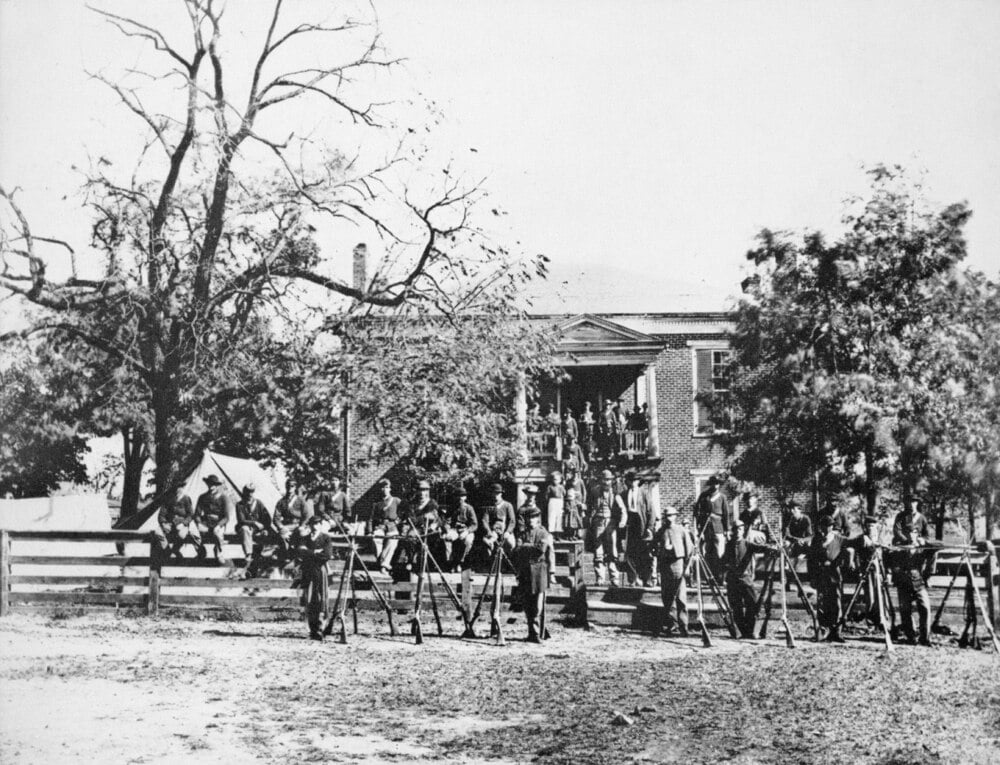
Three miles to the northeast, at the former county seat, known as Appomattox Court House, Gen. Robert E. Lee surrendered to Gen. Ulysses S. Grant, thus effectively ending the Civil War. The final battle of the Civil War took place at Palmito Ranch in Texas on May 11–12. The last large Confederate military force was surrendered on June 2 by Lt. Gen. Edmund Kirby Smith in Galveston, Texas. Yet Brig. Gen. Stand Watie, the first Native American to serve as a Confederate general, kept his troops in the field for nearly a month after Smith gave up the Trans-Mississippi Army. On June 23, Watie finally acknowledged defeat and surrendered his unit of Confederate Cherokee, Creek, Seminole and Osage troops at Doaksville, near Fort Towson (now Oklahoma), becoming the last Confederate general to give up his command. Lee, having abandoned the Confederate capital of Richmond, Virginia, after the nine-and-a-half-month Siege of Petersburg and Richmond, retreated west, hoping to join his army with Confederate forces, the Army of Tennessee in North Carolina.

Lee Surrenders to Grant
Secretary of War Henry Stimson warned that American cities should be prepared to accept “occasional blows” from enemy forces. It was the action on April 8, 1865 (the Battle of Appomattox Station), that determined the surrender would take place on April 9th in the village of Appomattox Court House. The advantage of position gained by the action on April 8, gave the Federals control of the strategic ground necessary to force Lee’s surrender. The New Yorkers retreated back along the stage road, gathering prisoners and shooting mules as they went, thus concluding the engagements on April 8. Please be aware that when a translation is requested, you will be leaving the Los Angeles Superior Court website. The Los Angeles Superior Court does not endorse the use of Google™ Translate.
HISTORY Vault: Black Patriots: Heroes of the Civil War
Grant had suggested in his correspondence that Lee choose the meeting place. American History Central (AHC) is the most widely-read independent encyclopedia dedicated to the history of the United States. Our ongoing mission is to provide teachers, students, and anyone interested in American History with entries, articles, primary documents, videos, and images that provide a solid understanding of the growth and development of the United States.
Explore This Park
Thereafter, both armies were entrenched, and a stalemate ensued for the next ten months. Despite being well-entrenched, the Confederate situation grew progressively worse as their supplies dwindled. By the spring of 1865, Lee knew that when the weather allowed, his army must escape the Union stranglehold or face starvation. After Lee left the McLean House on April 9, some of the Union officers present promptly bought much of the furniture in McLean’s parlor.
Nature - Appomattox Court House National Historical Park (U.S - National Park Service
Nature - Appomattox Court House National Historical Park (U.S.
Posted: Thu, 26 Feb 2015 08:00:00 GMT [source]
While Lee’s surrender at Appomattox Court House marked the end of the war in Virginia, it was not the end of the Civil War as a whole. Johnston’s Army of Tennessee was still being chased by Union Gen. William Tecumseh Sherman. Smaller Confederate armies continued to fight throughout the Deep South and west of the Mississippi River.
At the surrender ceremonies, about 28,000 Confederate soldiers passed by and stacked their arms.[28] General Longstreet's account was 28,356 officers and men were “surrendered and paroled”.[29] The Appomattox Roster lists approximately 26,300 men who surrendered. This reference does not include the 7,700 who were captured at Sailor's Creek three days earlier, who were treated as prisoners of war. The Battle of Appomattox Station commenced shortly after 4 pm and lasted until dusk with varying intensity, although more fighting continued in the direction of Appomattox Court House until probably 9 pm. The success of Custer’s troopers on the evening of April 8, dispersing and capturing Walker’s artillery and securing the Richmond-Lynchburg Stage Road were vital—the Federals now held the high ground west of Appomattox Court House, squarely across Lee’s line of march.
As the 5th Corps advanced, Custer and Brigadier General Thomas Devin’s divisions moved behind it—east on the LeGrand Road—putting additional pressure on the Confederate left flank as the Confederate infantry withdrew through the village. After a white flag had appeared on Custer’s front, General Martin Gary’s cavalry brigade disavowed the truce and attacks Custer’s advance, but the attack was quickly beaten back, suffering losses. The Dominguez Rancho Adobe Museum held festivities for the Battle of Dominguez Rancho, one of the few Mexican victories in the Mexican-American War, in October. The same happened in November at San Pasqual Battlefield State Historic Park in San Diego County, where Mexican forces led by Pico — who later on became a state Assembly member and senator — held the Americans to a stalemate.
Custer’s men made two or three probing assaults, none very anxious to get too close the walls of iron being thrown at them by the discharges of canister. Meanwhile, the Confederate batteries that were not engaged did their best to escape west towards Lynchburg or north towards Oakville. Appomattox Court House, in the American Civil War, site in Virginia of the surrender of the Confederate forces to those of the North on April 9, 1865. After an engagement with Federal cavalry, the Confederate Army of Northern Virginia was surrounded at Appomattox, seat of Appomattox county, Virginia, 25 miles east of Lynchburg.
These trains are loaded with supplies—clothes, blankets, equipment, ordnance, medical supplies, and most importantly—food. After moving along the wagon road beside the railroad, Custer’s men approach Appomattox Station from the southeast. The Station consisted of only a few houses with a squad of Confederate cavalry guarding the trains.
Lee briefly moved northward to Cumberland Church before retreating to the west. While at Cumberland Church he received a letter from Grant demanding his surrender. Despite mounting desertions and dwindling supplies, Lee refused Grant’s terms.
Commemoration of the 157th Anniversary of the Surrender and Freedom Day April 7-12, 2022 - Appomattox Court ... - National Park Service
Commemoration of the 157th Anniversary of the Surrender and Freedom Day April 7-12, 2022 - Appomattox Court ....
Posted: Tue, 08 Mar 2022 08:00:00 GMT [source]
His house was on the outskirts of the battlefield, and was used as Gen. P.G.T. Beauregard’s headquarters. After the battle, McLean began selling sugar to the Confederate Army, and moved to Appomattox Court House where he believed he would be able to avoid the fighting and the Union occupation, which impeded his work. After the war, McLean would famously observe that "The war began in my front yard and ended in my front parlor."
This event triggered a series of subsequent surrenders across the South, in North Carolina, Alabama and finally Shreveport, Louisiana, for the Trans-Mississippi Theater in the West by June, signaling the end of the four-year-long war. While it’s likely that the Battle of Los Angeles was only a mirage, it was still a chilling reminder of the vulnerability that many Americans felt at the beginning of World War II. The Japanese would later hatch several schemes to attack the American mainland—including launching over 9,000 explosives-laden “fire balloons”—yet none of them ever produced the level of mass hysteria that accompanied the phantom shootout over Los Angeles. Still, the most logical explanation for the firefight is that trigger-happy servicemen and rudimentary radar systems combined to produce a false alarm. In 1983, the Office of Air Force History outlined the events of the L.A.
Meanwhile, General George Crook directed General Ranald McKenzie’s small division of cavalry from the Army of the James, and a brigade under Colonel Samuel B. Young, to move up to support Smith on the left. They were met in turn by Rooney Lee’s Cavalry and likewise driven back, along with Smith. The Confederate infantry wheeled and opened the stage road and faced south while William Cox’s North Carolina brigade advanced along the stage road to the west. Martin’s battery fought aggressively on the Confederate left, continuously firing while boldly moving forward.
Grant was flattered that Lee remembered him from that time, as he was much younger than Lee and more junior in rank. The surrender of Lee’s Army of Northern Virginia sets the stage for the conclusion of the Civil War. Through the lenient terms, Confederate troops are paroled and allowed to return to their homes while Union soldiers are ordered to refrain from overt celebration or taunting. These measures serve as a blueprint for the surrender of the remaining Confederate forces throughout the South. Rather than destroy his army and sacrifice the lives of his soldiers to no purpose, Lee decided to surrender the Army of Northern Virginia. Three days later, a formal ceremony marked the disbanding of Lee's army and the parole of his men, ending the war in Virginia.
I went to Campo de Cahuenga, a small, lush, walled-off park across Lankershim Boulevard from Universal Studios and next to a Metro Red Line station. It has a lawn and trees and fountains and a replica adobe house filled with memorabilia from California’s Mexican era. The best place to begin your visit is at the visitor center inside the reconstructed court house.


No comments:
Post a Comment